Dressed for the Room: How What You Wear Becomes the First Thing a Lounge Hears You Say
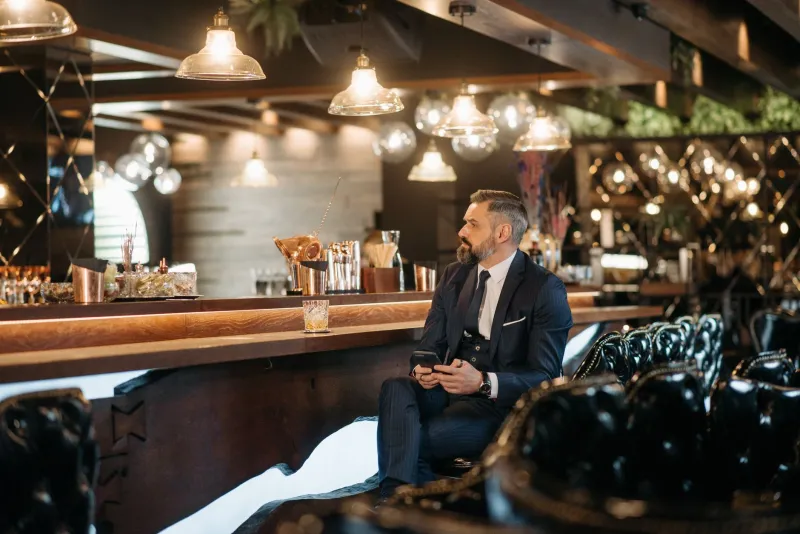
There is a conversation that happens before a single word is exchanged at the host stand. It takes place in the half-second between your arrival and the moment a staff member decides whether to extend a warm welcome or a politely worded redirection. That conversation is conducted entirely through fabric, silhouette, and intention. In the world of upscale lounges, dress is not merely aesthetic — it is the opening line of your evening.
America's lounge culture has long operated on a set of expectations that exist somewhere between the posted policy and the unspoken standard. What venues actually enforce, and what guests perceive, are often two very different things — and the gap between them is where most dress code misunderstandings are born.
The Policy Versus the Practice
Walk through the websites of marquee lounges in New York, Chicago, Miami, or Los Angeles, and you will find dress code language that ranges from the vague — "smart casual attire required" — to the aspirationally specific: "cocktail-appropriate dress encouraged." What these phrases rarely communicate is the living, breathing interpretation that plays out nightly at the door.
In practice, most upscale lounges operate with a hierarchy of discretion. A host or manager makes real-time judgments based on the totality of a guest's presentation: the condition of the clothing, the cohesion of the ensemble, and — perhaps most critically — the confidence with which the guest carries it. A well-tailored blazer worn with conviction reads differently than the same jacket paired with visible uncertainty. Lounges are not simply screening for garments; they are screening for guests who understand the environment they are entering.
This distinction matters because it shifts the conversation away from rigid rules and toward something more nuanced: cultural fluency. The guest who arrives having clearly considered the room, the occasion, and the evening's tone signals that they belong to the experience being offered. The guest who has not considered any of these things — regardless of what they are wearing — often signals the opposite.
City to City: How Standards Shift Across the American Lounge Map
The definition of "dressed appropriately" for an upscale lounge is not uniform across the United States, and treating it as such is itself a form of social miscalculation.
In New York City, the lounge dress code leans toward the architectural. Sharp lines, restrained palettes, and intentional layering are the vernacular. Downtown venues in the Meatpacking District or the West Village tend to reward guests who speak the language of fashion-forward minimalism, while Midtown establishments often favor a more classically polished presentation — the well-structured suit, the tasteful heel, the accessory that adds rather than overwhelms.
Miami operates under different atmospheric pressures. The heat, the proximity to the ocean, and the city's Latin cultural influences produce a lounge aesthetic that is simultaneously more expressive and more body-conscious. Vibrant color, form-fitting silhouettes, and elevated resort wear are not just tolerated — they are expected. A guest arriving in the muted tones appropriate for a Manhattan cocktail bar may find themselves visually underdressed in South Beach, not because their clothing is lesser, but because it does not speak to the room.
Los Angeles presents perhaps the most complex code of all, because its upscale lounge culture prizes a particular kind of studied nonchalance. The city's most coveted venues reward guests who appear effortlessly polished — where the sophistication is evident but the effort is concealed. Overly formal attire can read as out of touch; overly casual attire reads as disrespectful. The sweet spot is a narrow one, and navigating it requires genuine familiarity with the city's social rhythms.
Chicago brings a Midwestern sensibility to its nightlife dress standards — one that values quality and propriety without the performative edge of coastal markets. A sharp pair of trousers, a well-chosen dress, or a clean sport coat will open most doors with ease. Chicago's lounge culture tends to reward guests who dress with genuine care rather than those who dress to impress.
What Attire Actually Communicates
The deeper function of the lounge dress code is rarely discussed honestly, but it is worth naming directly: clothing signals whether a guest has done the work of understanding where they are going.
This is not gatekeeping for its own sake. Upscale lounges invest enormously in creating a specific atmosphere — in the acoustics, the lighting design, the service choreography, the curated music programming. A guest who arrives without regard for the environment disrupts the composition of the room in ways that affect every other guest's experience. The dress code, enforced or implied, is one mechanism through which venues protect the integrity of the atmosphere they have spent considerable resources constructing.
From this perspective, the right outfit is less about meeting an arbitrary standard and more about demonstrating that you have considered the experience you are entering. It is a form of respect — for the venue, for the other guests, and for the version of your evening that the lounge is designed to deliver.
The Evolution of Lounge Fashion Etiquette
It would be inaccurate to suggest that lounge dress codes have remained static. The last decade has produced meaningful shifts in what upscale venues consider appropriate, driven in part by broader cultural changes in how Americans relate to formality.
The rise of what fashion commentators have termed "elevated casual" — premium sneakers paired with tailored trousers, for instance, or a luxurious knit worn in place of a traditional blazer — has gradually been absorbed into the acceptable register of many upscale lounges. Venues that once enforced strict no-sneaker policies have revised their positions as the footwear landscape itself evolved. A $500 pair of minimal leather sneakers occupies different cultural territory than a worn athletic shoe, and discerning hosts have learned to make that distinction.
What has not changed — and what sophisticated lounge culture continues to uphold — is the expectation of intentionality. Guests who assemble their look thoughtfully, who demonstrate awareness of their environment, and who present themselves with a degree of care will find that most upscale lounges extend considerable goodwill in return.
Arriving Dressed for the Evening You Want
There is a practical dimension to all of this that deserves acknowledgment. If you are planning an evening at an upscale lounge — whether for a celebration, a business engagement, or simply a well-appointed night out — the most reliable approach is to research the specific venue rather than rely on generalized assumptions.
Examine the venue's social media presence. Note what the guests in their photography are wearing. Read any published dress code language carefully, and when in doubt, err toward polish. A slightly overdressed guest almost never gets turned away. An underdressed one frequently does.
Beyond logistics, consider what your attire communicates about your relationship to the evening itself. The lounge, at its best, is a curated experience — a deliberate departure from the ordinary. Dressing for it is not a burden. It is an invitation to participate fully in something that has been carefully designed for your enjoyment.
The room is already dressed. The question is whether you are dressed for the room.