Quiet Luxury in Motion: The New Lounge Design Language That Puts Conversation First
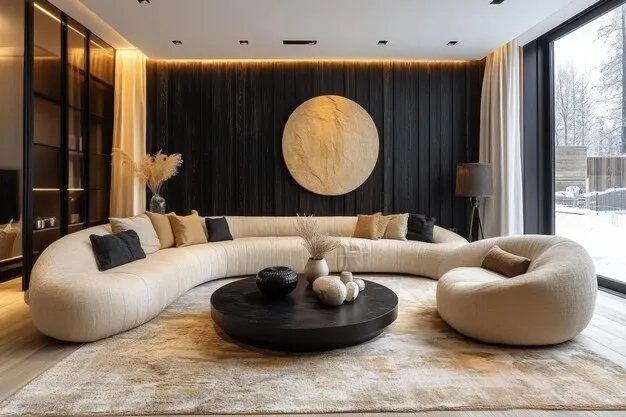
Photo: intimate upscale lounge interior warm lighting curved seating conversation design, via img.freepik.com
For much of the past decade, the aspirational lounge interior was defined by a particular visual logic: bold statement walls, dramatic pendant lighting, and the kind of architectural flourishes that photograph well at arm's length and look striking in a social media grid. The lounge, in this conception, was a backdrop — a stage set designed as much for documentation as for experience. Guests arrived, composed their shots, and moved through the space with one eye on the room and another on their screens.
That era, according to a growing number of designers, operators, and cultural observers, is drawing quietly to a close.
Across the country's most discerning urban venues, a countermovement is underway. It does not announce itself with manifestos or marketing campaigns. It announces itself instead through the arrangement of seating, the calibration of acoustic panels, the deliberate absence of mirrored surfaces, and the placement of lighting that flatters the face across a table rather than a camera lens. This is lounge design conceived for conversation — and it is redefining what premium nightlife looks and feels like in America.
The Problem with the Perfect Shot
To understand the current shift, it is worth examining what the previous design era optimized for — and what it inadvertently sacrificed. The maximalist lounge aesthetic emerged alongside the mainstream adoption of smartphone photography and the ascent of Instagram as a cultural arbiter of taste. Venues quickly learned that visually arresting environments generated organic social content, and that content generated reservations. The incentive structure was clear: design for the feed, and the guests will follow.
What this approach underestimated was the cumulative social cost of environments engineered for documentation rather than habitation. Spaces designed to be photographed tend to be experienced at a remove — observed rather than inhabited. The guest who spends twenty minutes composing the ideal image of their cocktail against a geometric tile backdrop is, in that time, not talking to the person across the table.
"We started hearing from guests that they felt exhausted by certain spaces," recalls a hospitality designer based in New York who has led interior projects for lounges in Manhattan, Miami, and Chicago. "Not physically tired — socially tired. The environment was demanding something from them constantly. They had to perform the experience rather than simply have it."
Designing for Presence
The architectural response to this fatigue has been methodical and, in some respects, counterintuitive. Where the previous generation of lounge design added — more texture, more color, more visual incident — the emerging philosophy tends to subtract. Surfaces are quieter. Palettes lean toward deep, absorptive tones that recede rather than demand attention. Lighting is warmer and more directional, illuminating the intimate zone of a table conversation without flooding the broader room.
Seating configurations have undergone perhaps the most consequential transformation. The communal table — long a fixture of the social lounge concept — is giving way to smaller, more enclosed arrangements: curved banquettes that curve inward, low-backed chairs angled toward one another rather than toward the room, and booth configurations that create a sense of enclosure without isolation.
"The goal is to make the person sitting across from you the most interesting thing in your field of vision," explains an architect who recently completed a lounge renovation in Austin, Texas. "That sounds simple, but it requires a significant amount of deliberate design work. You have to think carefully about sightlines, about what the eye is drawn to when it wanders, about how to gently redirect attention back to the table."
Acoustic design has emerged as a particularly critical element of this philosophy. Many of the country's most conversation-focused lounges now invest substantially in acoustic engineering — not to eliminate ambient sound, but to control it. The goal is a room that feels alive without being overwhelming: one where a couple can speak at a normal volume and hear each other clearly, while the broader hum of the venue provides energy and privacy simultaneously.
The Phone Question
Perhaps the most culturally charged dimension of this design shift is its implicit — and occasionally explicit — discouragement of phone use. Some lounges have approached this directly, implementing policies that request guests to store their devices during performances or late-evening hours. Others have pursued the same outcome through environmental design alone.
"If there's nothing in the room worth photographing, the phone stays in the pocket," observes a lounge owner in Washington, D.C., whose venue recently underwent a complete interior redesign guided by this principle. "We didn't ban phones. We just stopped designing for them. The result is the same."
This is not, operators are careful to note, a statement against technology or an exercise in nostalgia for some pre-digital golden age of nightlife. It is, rather, a commercial and philosophical bet — a wager that a meaningful segment of the American lounge-going public has grown sophisticated enough to actively seek out environments where presence is the default mode rather than the exception.
The early returns appear to validate that bet. Several lounge operators who have embraced conversation-first design report measurable increases in average guest duration — meaning people are staying longer — as well as higher rates of return visits and stronger performance on metrics tied to food and beverage spend per table.
What This Signals About Where Nightlife Is Headed
The conversation-first lounge is, in many respects, a reflection of a broader cultural negotiation that American society is conducting with itself about attention, authenticity, and the nature of shared experience. After years of optimizing social environments for visibility and reach, there is a discernible appetite for spaces that offer something more resistant to easy documentation: the texture of an unhurried evening, the quality of a conversation that could not have happened anywhere else.
For the urban lounge, this represents both a challenge and an opportunity. The challenge lies in resisting the gravitational pull of trends that remain commercially viable in the short term. The opportunity lies in serving a guest who is not simply looking for a night out, but for a particular quality of presence that only the right environment can provide.
The lounges that will define the next chapter of American nightlife are, it seems, the ones willing to design for the moment that cannot be captured — and trusted that their guests will come back precisely because of it.