Saying No with Style: The Graceful Etiquette of Declining a Drink Without Losing the Room
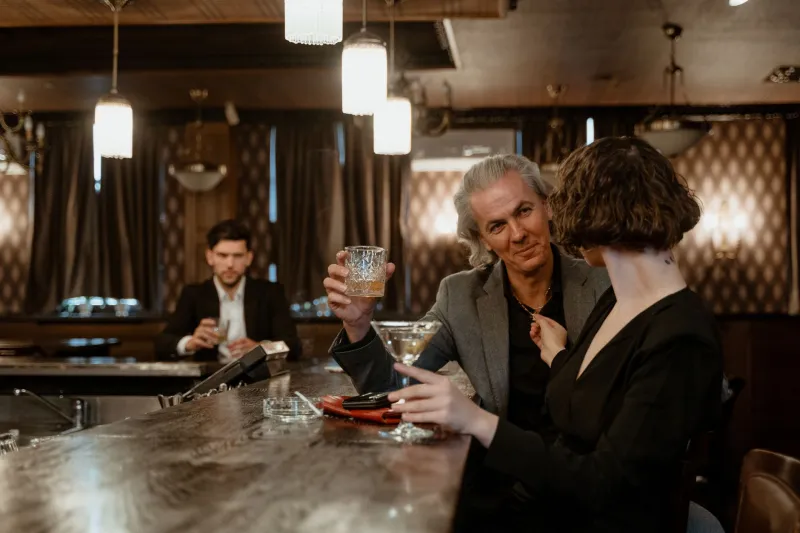
There is a particular kind of social theater that unfolds at the bar. Glasses are raised, rounds are offered, and the ritual of shared drinking becomes a quiet shorthand for belonging. In this setting, the word "no" can feel like a disruption — a minor but noticeable tear in the evening's fabric. And yet, the ability to decline a drink without deflating the atmosphere is not merely a matter of personal preference. It is, in its own right, a sophisticated social art.
At Avenue Lounge, where the evening is designed to flow effortlessly from arrival to last call, the question of how to gracefully step back from a round without stepping out of the conversation entirely is one worth examining with care.
Why the Refusal Feels Fraught
The psychology behind drink acceptance runs deeper than most people acknowledge. Across American social culture, the shared round carries symbolic weight. To accept is to signal openness, reciprocity, and investment in the moment. To decline, even politely, can be misread as disengagement — a subtle withdrawal from the warmth of the group.
This dynamic is particularly pronounced in upscale lounge settings, where hospitality is elevated to an almost ceremonial level. When a host orders a bottle of champagne to mark an occasion or a colleague insists on buying the next round, the refusal lands differently than it might at a casual bar. The stakes of the gesture are higher, and so, naturally, is the potential for awkwardness.
Understanding this underlying tension is the first step toward dissolving it. The graceful no is not simply about the words you choose — it is about the emotional intelligence you bring to a moment that others may feel more personally than they let on.
The Language of the Elegant Decline
Precision of language matters enormously in these situations. The most effective refusals share a common quality: they redirect rather than close. Instead of a flat "no thank you," which offers little for the conversation to hold onto, the practiced lounge guest pivots toward something affirming.
Consider the difference between "I'm fine, really" — a phrase that carries a faint trace of defensiveness — and "I'm savoring this one a little longer; it's too good to rush." The latter communicates appreciation for the setting, deference to the quality of what is already in your glass, and a kind of unhurried confidence that reads as sophistication rather than abstention.
Similarly, "I'll catch the next one" offers continuity. It signals that you are present, that you intend to remain present, and that the gesture of generosity is recognized and welcomed in principle. The key is to make the refusal feel like a pause rather than a period.
What You Order Instead
One of the most effective tools in the graceful decliner's arsenal is the substitution. Arriving at the bar or catching the server's attention to order sparkling water with a twist of citrus — served in a proper glass, not a utilitarian tumbler — accomplishes several things simultaneously. It keeps something in your hand, which matters more than people realize in social settings. It maintains your visual participation in the ritual of drinking. And it removes the conversational pressure entirely, because to the casual observer, you simply have a drink.
Many of the country's better cocktail bars and upscale lounges have expanded their non-alcoholic offerings considerably in recent years, a shift driven in part by the broader wellness movement and in part by a growing clientele that values presence over inebriation. A well-constructed zero-proof cocktail — garnished with the same intention as its spirited counterpart — is no longer a consolation prize. It is a legitimate choice, and ordering one with the same quiet confidence you would bring to a classic Negroni signals that you know exactly what you are doing.
Reading the Room Before You Respond
Context shapes everything. A birthday celebration at a reserved table carries different social expectations than a casual weeknight gathering at the bar. The person extending the offer matters, too. A close friend who knows your habits will read your refusal very differently than a new acquaintance who may be attempting to establish rapport through generosity.
In more formal settings — a business dinner that has migrated to the lounge for a nightcap, for instance — the graceful decline is often easiest when it is offered without explanation. Over-explaining signals discomfort. A simple, unhurried "Not tonight, but thank you" delivered with steady eye contact and a genuine smile is far more authoritative than a lengthy account of your early morning schedule or your current commitment to dry January.
Conversely, among close company, a touch of warmth and humor can defuse any remaining tension. "I'm already having the best time; another round might make me the most embarrassing person at this table" lands as self-awareness rather than refusal, and it invites laughter rather than concern.
Keeping the Conversation Alive
The true measure of a graceful decline is what happens in the thirty seconds that follow it. If the conversation resumes without interruption, you have succeeded. The way to ensure that outcome is to make the transition seamless — to decline and immediately re-engage, asking a question, returning to a thread that was in progress, or acknowledging something happening in the room.
The most socially fluent guests understand that the drink itself is rarely the point. It is the ritual around the drink — the gesture of offering, the act of gathering, the shared experience of the evening — that carries the meaning. When you honor that ritual through your engagement, your enthusiasm for the company, and your attentiveness to the conversation, the contents of your glass become almost incidental.
A Note on the Host's Perspective
For those on the other side of the exchange — the host, the generous friend, the colleague who has just ordered a second round — it is equally worth examining the impulse to press the issue. A gracious host accepts a refusal with the same ease they would accept acceptance. Insisting, even warmly, places the other person in an unnecessarily difficult position and, ironically, undermines the generosity the gesture was meant to convey.
The most elegant hosts at any upscale lounge are those who extend the invitation once, receive the response without commentary, and ensure that their guest's glass — whatever it contains — is never empty.
The Quiet Confidence of Knowing Your Evening
Ultimately, the art of declining a drink with grace is an expression of self-possession. It requires knowing what you want from an evening, communicating that clearly without apology, and remaining fully present in the social world around you. That combination — clarity, warmth, and engagement — is precisely what defines a sophisticated guest.
The lounge, at its best, is a place where the evening belongs to you. How you shape it, what you choose to consume, and how you navigate its rituals are all expressions of the same underlying confidence. The graceful no, when delivered well, is not a withdrawal from the room. It is, in its own quiet way, a statement of arrival.